
Google Ads for Local Businesses: The 3-Part Scale Framework
As we outlined in our foundational post, Welcome to The Digital Briefing, most businesses do not suffer from a lack of access to powerful tools. They suffer from a utilization problem. They treat ad platforms like a gym membership, paying the monthly fee, setting up a default campaign, and hoping the algorithm magically delivers high-value clients to their door.
But as the core philosophy of this publication dictates: technology doesn’t solve broken operations; it amplifies systems. Good systems get amplified for the better; bad systems just burn cash faster.
When independent business owners or performance marketers look to run Google Ads for local businesses, they often fall into the trap of treating all local traffic the same. They build a generic campaign, throw in some local keywords, and wonder why their margins are paper-thin.
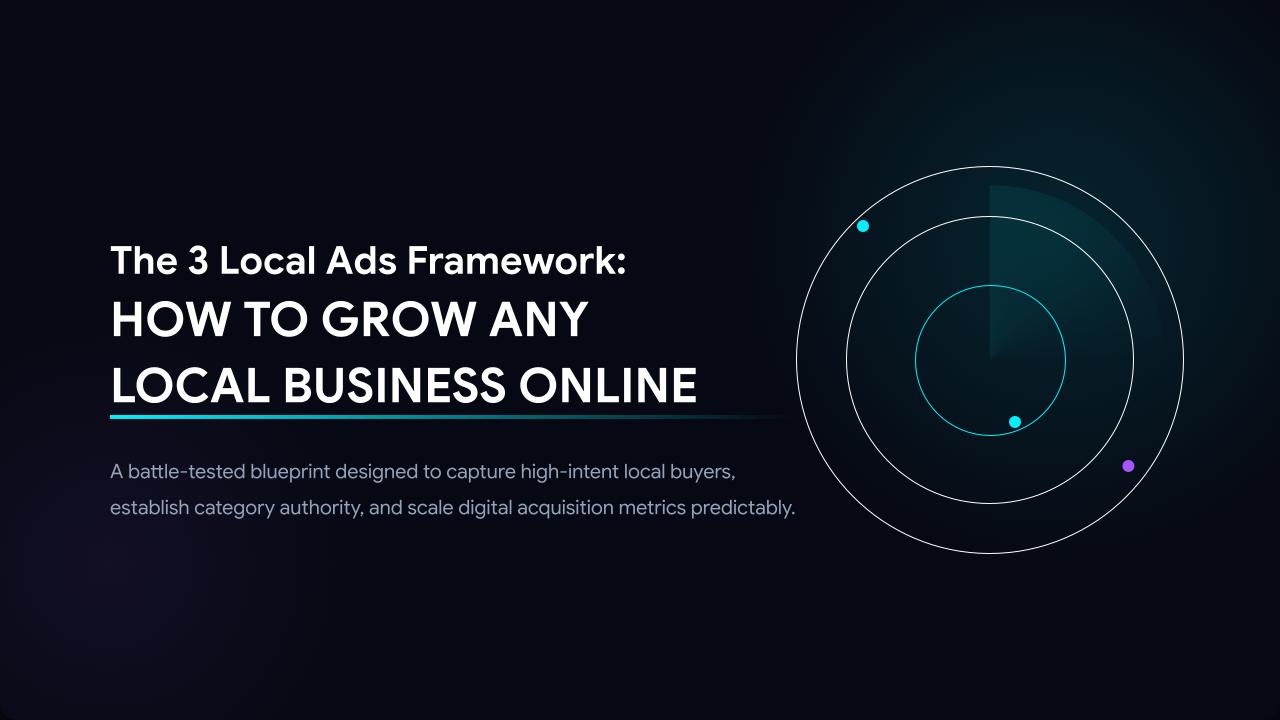
To build a truly predictable local growth engine, you have to stop looking at your business through a generic marketing lens and start looking at your customer through an operational lens. You must divide your local market into three distinct psychological intent buckets.
Decoding the Three Intent Buckets for Local Businesses
Before touching a single button inside an ad account, you must understand exactly how your customer makes a buying decision.
What is intent-based local marketing? It is an operational framework that segments local service advertising into three distinct psychological states; High-Urgency, Desire-Driven, and Long-Cycle Investments. Instead of relying on automated platform defaults, it forces the advertiser to match the ad architecture directly to the speed and friction of the consumer’s buying decision.
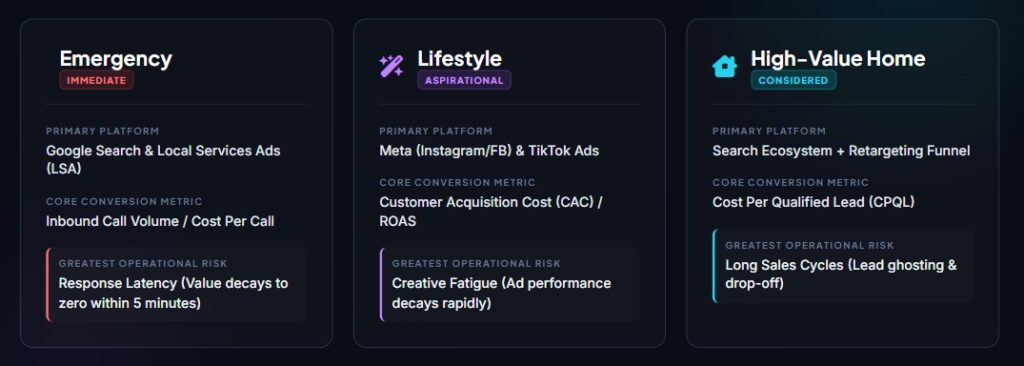
1. The Emergency Vertical (High-Urgency Systems)
The customer has water actively flooding their kitchen at 2:00 AM, or their AC unit just died in the middle of a 40°C heatwave. They do not care about your beautifully curated brand story, and they are not going to read your blog. They are in a state of sheer panic, and they want an immediate operational solution.
The most common mistake here is under-utilization of the platform. Marketers turn on a Responsive Search Ad (RSA), apply broad match, enable smart bidding, and cross their fingers. Broad match without rigorous guardrails will aggressively match your ads with irrelevant queries, blowing through your budget before lunch.
The “Basic 4 + 1” Asset Rule
To win the panic economy, you must fully utilize Google’s ad assets to occupy real estate on the search page and drive immediate clicks. Every emergency campaign requires the basic three assets active:
- Call Assets: Input your primary and most responsive contact number.
- Callout Assets: Short, punchy text highlighting your speed (e.g., “24/7 Rapid Response,” “30-Min On-Site Arrival”).
- Structured Snippets: Definitive lists of what you actually fix (e.g., Services: Sump Pumps, Burst Pipes, Leak Detection).
- Sitelinks: Direct routes to specific critical subpages (e.g., Emergency Drain Cleaning).
The Multiplier: You must activate the Messaging Asset. Giving a panicked user the ability to initiate a direct WhatsApp or text conversation straight from the mobile ad component captures a massive wave of high-intent users who cannot or do not want to make a voice call in a chaotic moment. It is important to note that the message asset may not be available to you, sometimes until a few weeks into the campaign. This happens because Google requires a history of policy compliance. Also, the feature is still in beta as per this official article on Google Ads’ message asset.
The Localization Loop
If you operate in a diverse local market, do not group everyone into a single English-speaking campaign. Split your campaigns to target local languages separately. Route those variations to dedicated landing pages or unique WhatsApp numbers to effectively monitor the operational output. Google’s keyword algorithm has come a long way in understanding search intent in local languages, but it does not eliminate the need for manual, routine negative keyword scrubbing to eliminate DIY search terms.
Once the tech delivers the lead, it’s entirely down to your operational speed: your ability to listen and respond fast is the ultimate breaking factor.
READ THE DEEP-DIVE: Spoke 1 – Google Ads for High-Urgency Local Services
2. The Wellness & Lifestyle Vertical (Desire-Driven Systems)
For Med Spas, boutique gyms, and aesthetics, the customer isn’t solving a crisis; they are buying a transformation or a status shift.
The standard agency playbook is to run cheap “promo bait” (“Get your first session for $1!”). While this strategy looks incredible on an agency dashboard because it floods the top of the funnel with cheap lead forms, it creates an operational nightmare for the business owner. It attracts low-LTV bargain hunters who will consume your staff’s time and vanish the moment you try to transition them to sustainable retail rates.
The Friction-Reduction Retargeting Sequence
Instead of selling your business short with discounts, your system should focus on creating genuine demand. Use top-of-funnel ads to showcase premium, authentic imagery and clean facilities. Once a user demonstrates interest, move them into a remarketing sequence designed to reduce psychological friction and build trust:
- Focus on Your USP: Explain exactly why your service stands out. Do not compete on price; compete on operational execution.
- The Human Advantage: In an industry frequently saturated with cold environments or aggressive sales tactics, simply highlighting a “friendly, expert staff” can completely shift a prospect’s response.
- Optimize for Appointments: Direct your campaign’s technical conversion signal toward confirmed appointments, not empty vanity metrics like likes or comments.
The Asset Audit Warning
You can build a flawless remarketing sequence, but it means nothing if your online presence is a mess. It is terrifying how many local lifestyle businesses spend thousands on ads but route their social media profiles or bio links to expired domains, typos, or compromised links. Audit your digital ecosystem weekly. Ensure your Google Business Profile is optimized, actively request reviews from your top clients, and make sure you aren’t accidentally routing your hard-earned traffic to a broken link or a gambling site.
READ THE DEEP-DIVE: Spoke 2 – Scaling Wellness & Lifestyle Verticals
3. The High-Value Home Vertical (Long-Cycle Investments)
Kitchen remodels, luxury landscaping, solar arrays. These projects carry five- or six-figure contract values and months-long consideration cycles.
The primary failure point here is advertiser panic. Because the value generated per user is so massive, these keyword auctions feature incredibly high Costs-Per-Click (CPCs) and slower, deliberate conversion rates. Inexperienced marketers look at a high CPC, panic, and begin making daily tweaks to their ad copy and bidding strategies in hopes of forcing a quick lead.
This emotional over-tweaking completely ruins the platform’s data engine and makes your performance significantly worse.
The Unit Economics Perspective
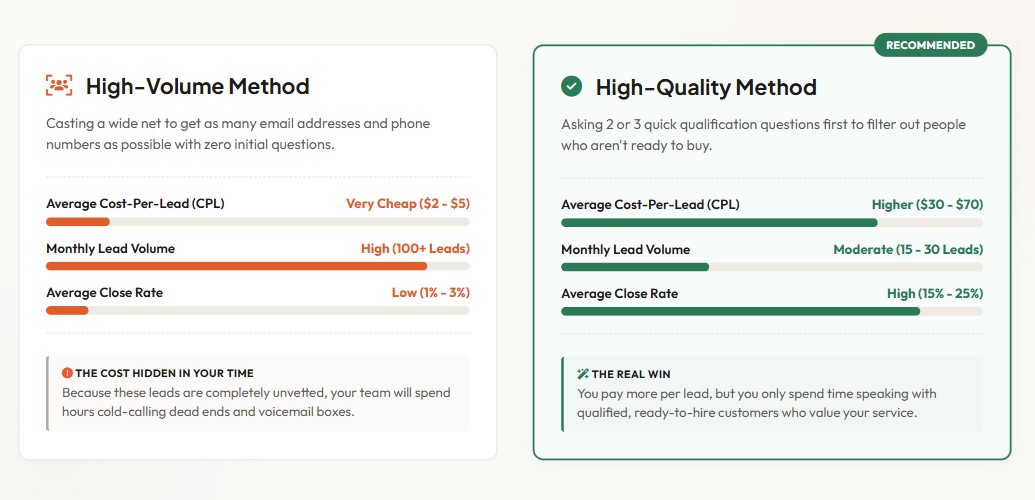
To scale a high-value vertical, you must maintain a strict macro perspective. A single closed conversion in this space can cover your entire monthly ad budget with plenty of profit left over.
Knowing this allows you to step back, maintain emotional stability, and ensure that flawless best practices are uniformly applied across the Google Suite and your social platforms so high-intent prospects aren’t lost to technical friction.
The Two-Stage Qualification Filter
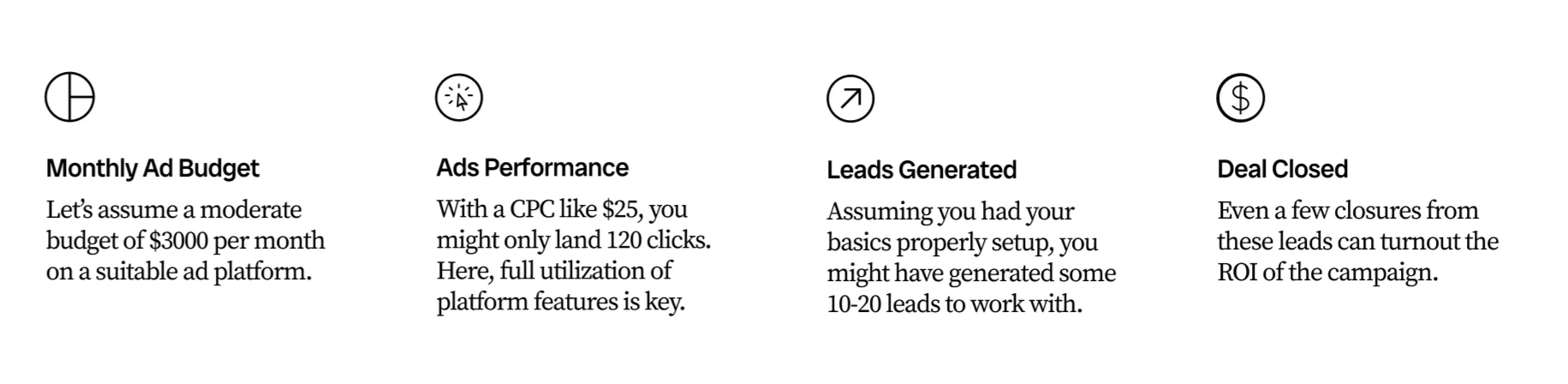
Because your ad spend is premium, your human sales bandwidth must be fiercely protected. Do not let your team waste hours drafting custom project blueprints for tire-kickers who don’t own the property or have unrealistic financial expectations.
Deploy an automated, pre-templated questionnaire directly into your intake flow to rapidly qualify leads before a human ever schedules a call. Your template must filter for two non-negotiables:
- The Decision-Maker: Are you speaking directly with the deeded property owner or someone with immediate access to the financial sign-off?
- Expectation Alignment: Do their timeline and self-selected budget tier align with the reality of a premium service provider?
Once a lead passes this digital guardrail, immediately shift to high-touch operations. Encourage an immediate site visit for an on-site project assessment. This is where real rapport is built, and in this line of business, face-to-face trust is the ultimate breaking factor that closes the deal.
READ THE DEEP-DIVE: Spoke 3 – How to Market Big-Ticket Home Services
The Actionable Takeaway Checklist
If you want to stop treating your marketing like a gym membership and start fully utilizing your digital tools, execute this operational checklist before spending another dollar of your budget:
- [ ] Complete a Free Google Ads Certification: Before executing campaigns, force yourself or your junior marketer to go through baseline platform training. Understanding the mechanical levers of the software prevents catastrophic revenue loss later in the game.
- [ ] Execute a Digital Asset Audit: Manually click every single link in your social media bios, Google Business Profile, and ad extensions today. Verify that no traffic is being routed to broken pages or unverified domains.
- [ ] Map Your Intent Bucket: Identify which of the three frameworks matches your target consumer’s psychological state and rebuild your ad copy, landing pages, and assets to match that exact speed of decision-making.
Technology will never step in and fix a fundamentally chaotic business operation; it will only amplify what is already there. Build the system first. Then let the software scale it.
(Writer’s Note: Lilith, our resident black cat, has thoroughly inspected this framework, walked across my keyboard twice during editing, and formally approved it for human implementation. You’re good to go.)
Berminat dengan perkhidmatan kami?
Kongsi emel atau nombor WhatsApp anda untuk konsultasi percuma tentang projek anda!

Tech Briefing
Penyumbang yang memberi tumpuan kepada analisis teknologi praktikal, strategi perisian dan pandangan transformasi digital.