
Spoke 1: Google Ads for High-Urgency Local Services: The Panic Playbook
This article is a branch-off from the main article: The 3 Local Ad Frameworks: How to Scale Any Local Business Online
When a pipe bursts at 2:00 AM and floods a kitchen, the homeowner is not sitting on their couch casually comparing brand color palettes or reading a local plumber’s “About Me” page. They are in a state of sheer panic. They open Google, type a high-intent phrase, and click the very first thing that promises to stop the water.
This is the world of high-urgency local services—HVAC, plumbing, roofing, towing, and locksmiths. The marketing model here is purely transactional, immediate, and binary: you either capture the panic instantly, or you lose the job to the competitor who was one slot higher on the page.
Yet, despite the simplicity of the consumer’s psychology, this is where most local ad budgets go to die. Marketers and business owners log into Google Ads, accept every default setting the interface throws at them, and wonder why they’re burning cash without moving their revenue line.
The Automated Default Trap in High-Urgency Local Services
The most common operational failure in high-urgency advertising is a total underutilization of the platform’s advanced levers. A well-meaning marketer or busy business owner will spin up a modern Responsive Search Ad (RSA), dump in a handful of broad-match keywords, enable automated smart bidding, and cross their fingers.
On paper, Google’s machine learning is supposed to handle the rest. In reality, relying completely on automated defaults without manual guardrails is a guaranteed way to let the software run away with your margins. Broad match in a local urgency setting is a wild animal. If you bid broadly on “plumber,” Google’s algorithm might decide your ad is a great fit for someone searching for “how to fix a loose toilet handle myself” or “plumbing trade school tuition.”
You pay for those clicks, but your phone never rings. To win in the panic economy, you have to force the software to work within strict operational constraints.
The “Basic 4 + 1” Asset Stack
If you want to maximize your ad strength and capture real estate on the search engine results page (SERP), you must stop ignoring your ad assets. Assets—formerly known as extensions—are pieces of extra information appended to your text ad. Leaving them blank is the digital equivalent of buying a billboard and leaving the bottom half white.
Every emergency campaign requires the Basic 4 assets, no exceptions:
- Call Asset: Allows your ads to be accompanied with a click-to-call button that users that press to open the dialpad.
- Callout Assets: Short, punchy text snippets highlighting immediate operational advantages (e.g., “24/7 Emergency Service,” “Arrive in 30 Mins,” “Licensed & Insured”).
- Structured Snippets: Categorized lists that tell the prospect exactly what you fix before they click (e.g., Services: Water Heaters, Sump Pumps, Leak Detection).
- Sitelinks: Direct links to deep subpages on your site, allowing users to self-route if they have a specific critical issue (e.g., Emergency Drain Cleaning).
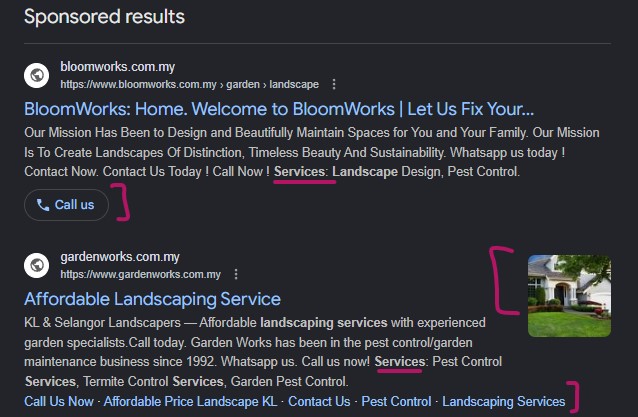
Once you have the Basic 4 active, you must deploy the ultimate multiplier for modern mobile traffic: The Messaging Asset. By configuring direct text lines or WhatsApp click-actions straight from the ad component, you open a secondary conversion channel for prospects who can’t—or don’t want to—make a voice call while their house is in chaos.
The Localization Loop: Language Splitting and Manual Scrubbing
If you operate in a diverse local market, treating your entire territory as a single, English-speaking monolith is an expensive mistake.
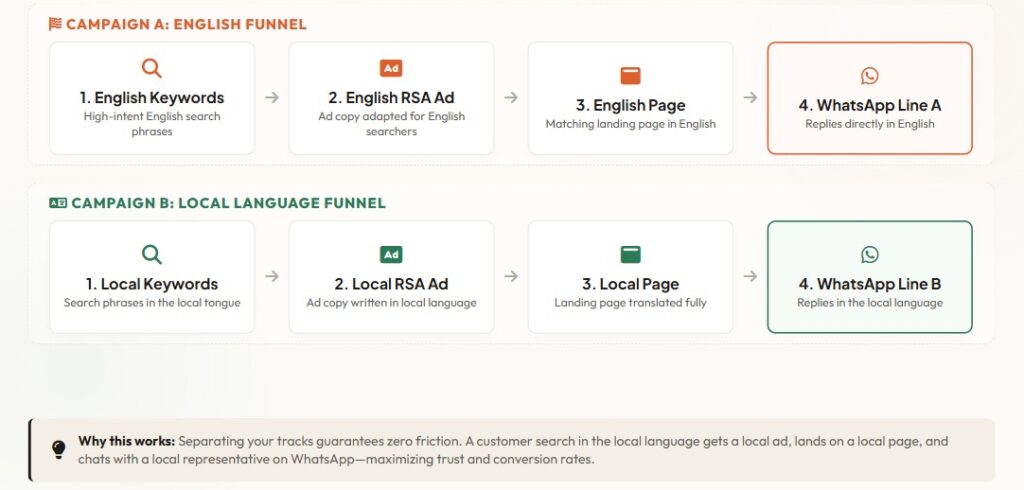
To gain a significant edge over competitors, you should actively split your target audiences into separate, distinct campaigns mapped to local languages. Google’s intent matching has become incredibly sophisticated at mapping non-English search phrases to local intent, but you shouldn’t rely on it to translate your messaging dynamically.
- Build separate campaigns for different local languages.
- Route those campaigns to dedicated, language-specific landing pages.
- Assign unique phone numbers or WhatsApp click-lines to each language variation so you can monitor the precise operational output and conversion efficiency of each demographic.
However, splitting your campaigns doesn’t absolve you from the unglamorous, manual grunt work. Much like a standard campaign, local-language setups require routine, aggressive negative keyword adjustments. You must sit in the search terms report multiple times a week, hunting down and excluding informational queries, DIY phrases, and out-of-market location signals.
The Operational Hand-Off
Once your ad architecture is airtight and the platform is fully utilized, the technology has done its job. The ball is officially in your court.
In the emergency vertical, lead velocity is everything. If a panicked homeowner calls or sends a WhatsApp message and meets an unanswered line or a slow response, they will hang up and click the next ad down the list within eight seconds. Winning high-urgency local marketing requires an organizational capability to listen intensely and respond at lightning speed. The ad platform can buy you the opportunity, but your operational speed closes the deal.
Return to the main article: The 3 Local Ad Frameworks: How to Scale Any Local Business Online
Interested in our services?
Share your Email or WhatsApp for a free consultation on your project!

Tech Briefing
Contributor focused on actionable technology analysis, software strategy, and practical digital transformation insights.