
Spoke 3: How to Market Big-Ticket Home Services: The CPC Playbook
This article is a branch-off from the main article: Google Ads for Local Businesses: The 3-Part Scale Framework
In the local service landscape, marketing big-ticket home services, such as custom kitchen remodels, premium hardscaping, architectural landscaping, and full-home solar arrays, exists in an entirely different financial universe than emergencies or beauty treatments.
Here, the average contract value doesn’t sit at $200 or $2,000; it starts at $20,000 and can easily scale past six figures. Because the stakes are incredibly high, the marketing mechanics require a complete rewiring of your tactical expectations. If you apply the fast-paced, high-velocity ad playbooks of smaller local niches to big-ticket investments, you will pull your hair out within two weeks.
The Advertiser Panic Loop
The single biggest mistake young performance marketers and high-ticket business owners make in this vertical is succumbing to short-term data panic.
When you launch a Google Ads or Performance Max campaign for a high-end home remodeler, the keyword auction is fiercely competitive. You are going to experience significantly higher Costs-Per-Click (CPCs) compared to almost any other local vertical, alongside painfully slow, extended conversion cycles.
Seeing a single click cost $40 or $80 causes inexperienced advertisers to panic. They look at a dashboard that has generated zero leads after four days of spending, experience an emotional pull-out, and begin making numerous daily tweaks to the targeting, bidding, and ad copy in a desperate attempt to force the algorithm to perform.
This emotional over-tweaking is lethal. Every time you fundamentally alter a local campaign, you reset the platform’s learning phase, corrupting its data engine and making your overall performance significantly worse.
The Macro Shift in Big-Ticket Home Services
To run big-ticket local campaigns without losing your mind, you must anchor your strategy in basic unit economics. You have to maintain an operational perspective on your return on ad spend (ROAS).
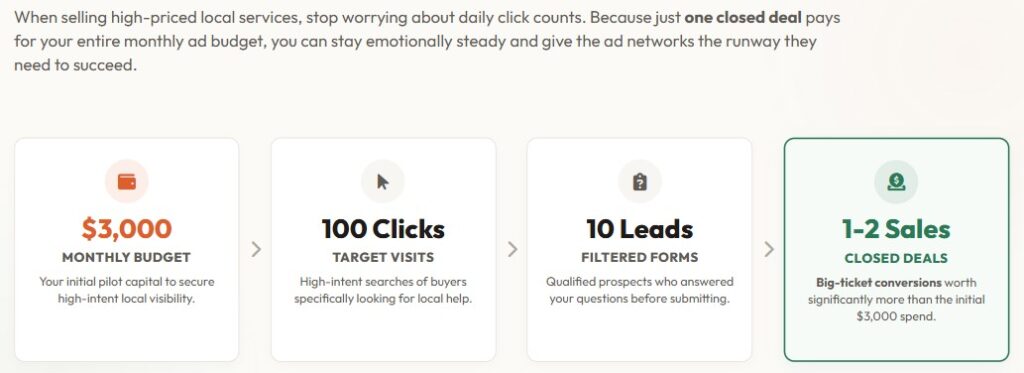
When you look at the math clearly, you realize that a single closed conversion in this vertical has the power to cover your entire monthly marketing budget with substantial profit leftover. Knowing this allows you to maintain absolute emotional stability, step back, and give the Google Suite and your social platforms the necessary time and data runway to optimize correctly.
Instead of constantly messing with the knobs, your job is to ensure that flawless, platform-wide best practices are uniformly applied across your ads, business profiles, and social landing pages to prevent a single high-intent prospect from slipping through the cracks.
The Two-Stage Digital Qualification Filter
Because clicks are expensive and lead generation is slow, the leads you do capture must be pristine. The last thing a boutique landscaping or remodeling company needs is their limited, high-value sales staff spending hours drafting custom design blueprints for tire-kickers who have a $500 budget and a rented property.
To protect your operational capacity, you must deploy a systematic qualification framework using digital assets before any human touchpoint occurs. This can be rapidly concluded using an automated, pre-templated questionnaire built directly into your landing page or lead capture sequence.
Your digital intake template should instantly filter for two critical data points:
- Decision-Maker Status: Are you communicating directly with the deeded homeowner and primary decision-maker, or someone distant from the final financial sign-off?
- Expectation Realism: Does the prospect’s self-selected budget tier and project timeline align with the actual operational reality of a premium service provider?
Breaking the Deal: The Pivot to Rapport
Once a prospect passes through your automated digital qualification filter, you stop marketing and immediately pivot to high-touch sales operations.
In big-ticket home services, a digital relationship can only take you so far. The ultimate breaking factor that closes five-figure and six-figure deals is human trust. Your system should be entirely engineered to encourage an immediate, seamless site visit for an on-site project assessment.
The site visit serves a dual operational purpose: it allows your technical team to accurately assess the physical scope of the project, and it gives your sales leader the exact environment needed to build deep, face-to-face rapport and assess the client’s long-term fit. Use your technology to aggressively filter the noise, so you can deploy your human energy exactly where it matters most.
Return to the main article: Google Ads for Local Businesses: The 3-Part Scale Framework
Berminat dengan perkhidmatan kami?
Kongsi emel atau nombor WhatsApp anda untuk konsultasi percuma tentang projek anda!

Tech Briefing
Penyumbang yang memberi tumpuan kepada analisis teknologi praktikal, strategi perisian dan pandangan transformasi digital.