How to Get Clients and Freelance without Upwork or Fiverr
Tech Briefing Jun 7, 2026 9 min bacaan
If you want to start a freelance service business, the standard internet playbook tells you to go to Fiverr or Upwork, set up a few sleek gigs, write an enticing bio promising the moon, and wait for the cash to roll in. But if you want to skip the race to the bottom, you need to learn how to get freelance clients without relying on Upwork, Fiverr, or other highly competitive digital marketplaces.
The brutal reality of these digital marketplaces is that you are completely invisible until you have recognition. Sure, the platforms might have minor “fairness techniques” engineered to give newcomers a tiny bit of visibility, but you are still an unrated novice nonetheless. No matter how hard an algorithm vouches for you, or how bold the claims in your bio are, clients will always remain deeply cautious of working with someone who has zero track record.
To survive, you have to understand how these ecosystems actually operate:
Fiverr is reactive: You set up your shop and wait for small, consistent, highly transactional jobs to come to you.
Upwork is proactive: You actively search through job feeds and burn through connects to send proposals for typically higher-value jobs.
Direct Outreach is a sovereign hustle: You find the clients yourself.
If you set up a fresh Fiverr account, optimize your keywords, and build a nice portfolio, you might land 10 to 100 impressions a day depending on your niche’s demand. But on Fiverr, you cannot even pay to advertise your gigs until you reach Level 1—which requires a mandatory minimum of 10 completed orders and $400 in earnings.
That massive, dry gap between Level 0 and Level 1 is the exact graveyard where most freelancers fail. They either get no jobs, run out of patience, or both. I have been there, and I failed a lot of times. It took me a long time to realize that my expectation that clients would magically come to me was entirely unnatural.
If you want to survive the Level 0 graveyard, you have to stop treating these platforms as search engines. You need to treat them strictly as checkout counters and review aggregators. You have to seek your clients manually, provide your services, and pull those direct relationships back into the platform to force the algorithm to wake up.
Outreach Case Study: How to Get Freelance Clients via Direct Messaging
For months, I fell into the trap of sending cold, generic blast emails, and I got absolutely nowhere. Everything changed when I stopped blasting and started listening.
While scrolling through Facebook, I noticed a local handyman service making four to six posts a day on their page, aggressively pushing a call-to-action. It was incredibly loud, raw, and high-effort. They were clearly desperate for attention, but they obviously had no strategic or operational clue what to do with it.
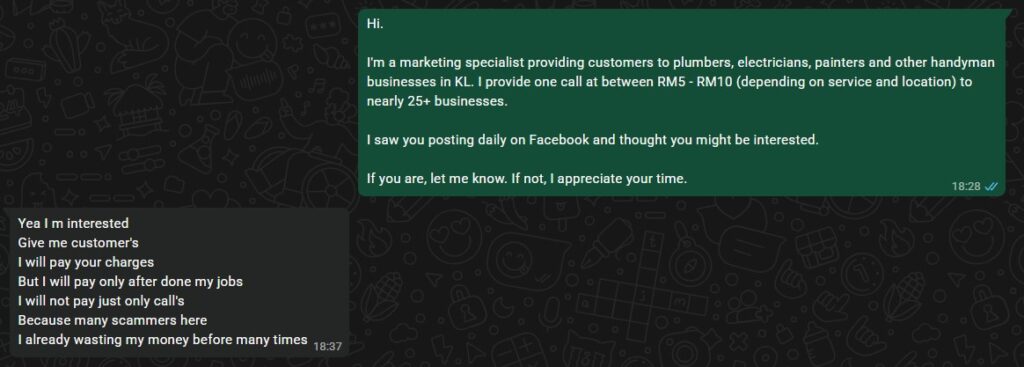
I didn’t send them a 12-page pitch deck. I slid into their direct messages with an incredibly straightforward, no-BS note:
“Hey, I see you’re posting a lot. I can help you get clients for a few bucks.”
The raw, direct message that secured thousands of dollars in freelance contracts.
Was it the most polished, preferred corporate response? Absolutely not. But it cut straight to the pain. Once I met the client and explained the actual process, that single, raw DM turned into thousands of dollars in deals for custom website development and ad marketing.
Sure, I got a bit lucky there, but it proves a fundamental point: local and independent businesses have accessible decision-makers. You don’t have to fight through a corporate hierarchy or an automated HR tracking system; you just have to target real, visible problems and message the owner or stakeholder directly.
I’m also aware that the business’s response in this example is the nightmare of any freelancing digital marketer. However, these are common challenges that you will face when pushing your services. Establish trust and offer your services at a discount to push your deals forward and build clientele and momentum.
Here’s a pro-tip: Use Facebook search to find people looking for your services. You’d still have a far better chance pitching yourself there than at Upwork or Fiverr – assuming that you do carry some skills.
If you’re a fresh graduate or you’re unskilled, this might be a step ahead. Not to say that you can’t learn on the job, but you’d probably want to invest time picking up some knowledge and a couple of relevant skills because it will absolutely impact how well you obtain or retain freelance clients.
The $0 Freelance Tech Stack for Sourcing Clients
Building a client pipeline doesn’t require expensive software. You can source, pitch, and close high-paying contracts using this exact four-part free freelance tech stack:
Sourcing & Outreach: Standard Facebook or LinkedIn profiles for manual prospecting.
Client Communication: Personal WhatsApp or Messenger for instant, high-trust direct access.
Market Research: Google Ads Keyword Planner, Google Trends, and free LLMs.
Visuals & Deliverables: Canva, Google Slides, Figma, and Photopea.
The most common excuse people make for not hunting direct clients is that they don’t have the budget for a “professional” setup. They think they need an expensive corporate domain, automated email sequences, and a fancy CRM suite.
Small business owners do not care about your tools; they care about results. In fact, heavy corporate branding often backfires with independent operators—to them, a hyper-polished corporate facade just sounds like overhead and money leaving their pockets.
I am incredibly strict with budgets, and even as a professional freelance digital marketing expert, I run almost my entire freelancing operation using completely free tools. You can copy this exact stack tomorrow for zero dollars:
Sourcing & Outreach: Your regular, everyday Facebook account, LinkedIn profile and Maps. No premium subscriptions, no automated scrapers. Find the business, locate the owner, and send a message.
Communication: Standard, personal WhatsApp or Messenger. It is immediate, high-friction, and implies that the client has a direct line to the person actually building the solution. If they are local, offer to meet in person. If they are completely remote, open up free, standard identity verification channels to establish baseline trust.
Visuals & Pitch Decks: Simple, powerful design platforms. Use Canva or Google Slides for pitches, Figma for quick website mockups, and Photopea for free browser-based photo editing. Source your high-res imagery from Unsplash.
When you reach out, your messaging should always follow a single, unbending rule: Focus entirely on value, never on features.
An independent businessman doesn’t know what a “conversion pixel” or a “click-through rate” is, and they don’t care. Your pitch should always boil down to: “This is who I am. This is what I can do for your business. It will either cut your costs or bring you money.” If your solution does neither, you are never going to match frequencies with a small business owner.
The Trapped-Value Shortcut: Escaping the Freelance Platform Graveyard
To successfully execute this $0 stack, you do need to know how to use your tools effectively before you pitch. This is where people completely underutilize free online education.
You do not need a hyper-technical degree or an expensive paid bootcamp. Free platforms like the Google Ads Certification suite or FreeCodeCamp’s programming tracks are goldmines. The benefit of these certifications isn’t the digital badge you put on LinkedIn; it’s that they force you to learn the full, end-to-end capabilities of a software. Once you deeply understand what a tool can physically accomplish, you gain the confidence to market yourself and spot the operational flaws of businesses that are using them incorrectly.
Once you land a direct client through Facebook or LinkedIn using your free skill set, you apply the ultimate platform workaround.
Instead of invoicing your direct client normally, you tell them transparently:
“Hey, I’m currently scaling up my digital storefront on Fiverr. If you make the payment and leave an honest review of my service through this platform link, I’ll drop my price by 20% right now to cover the platform fees and thank you for the trouble.”
If you want to gain long-term algorithmic traction, sacrificing a minor 20% cut on a few early jobs to secure guaranteed 5-star reviews is a massive win. And honestly? If you’ve built an excellent, high-trust relationship with the client through your direct communication, you can often ask them to handle the transaction through Fiverr shamelessly without offering a discount at all.
Now I know you are wondering, “Hey, what about Fiverr though? Are they down with this?“
This has been a concern for the freelancing community on these platforms, and it has been asked in this Fiverr community discussion. This is also supported by Fiverr’s own referral program, which allows you to share your Gig outside Fiverr to refer a buyer into the platform. The answer is yes. You can even refer buyers into the platform, and as long as the process is ethical, you should have no issues.
Once those direct reviews hit your profile, you will blast past the Level 0 graveyard and unlock Level 1 status. Furthermore, you would also have case studies or a portfolio that you can then attach to your profile.
Now, the platform’s internal traffic engine actually kicks in, you unlock paid advertising, and you are finally enabled to scale. More importantly, you will have actually learned how to actively sell yourself instead of passively waiting for an app to hand you a living.
Final Thoughts
Taking absolute charge of your own destiny makes a massive difference in your professional drive. If you sit around waiting for an Upwork proposal or a Fiverr algorithm to choose you, you will eventually get bored, tire out, and quit. But when you realize that you have the tools to actively hunt, you become unstoppable.
Rejection is entirely a part of the game. You will get ignored. You will have times where you feel like you’re about to get scolded, and you will get plenty of plain, blunt “no thanks” responses. It’s completely alright. Rejection won’t kill you, and you’ll learn from every single one of them.
Stop waiting for a piece of software to grant you permission to be a freelancer. Find a broken process, message the owner, and build the system yourself.
Now, if you’ll excuse me, Lilith has decided that my keyboard is an acceptable location for her mid-morning nap. Given that she outweighs my editorial authority, I am officially off the clock until further notice.
What about you? What is the most unconventional way you’ve ever landed a client or a job? Let’s drop the corporate filters and talk about the real hustle in the comments below.
Frequently Asked Questions About Online Freelancing
Q: Is it against Upwork or Fiverr terms of service to take clients off-platform?
A: Yes, “circumvention” (taking a client you met on Upwork/Fiverr away from the platform) can get you banned. However, finding a client independently via direct outreach and bringing them onto the platform to process payment is entirely compliant and encouraged.
Q: How do you handle rejection during direct outreach?
A: Rejection is a data point. If businesses ignore you, your hook isn’t sharp enough. If they say “no,” your offer doesn’t align with their current pain points. Pivot, refine your message, and move to the next prospect.
Berminat dengan perkhidmatan kami?
Kongsi emel atau nombor WhatsApp anda untuk konsultasi percuma tentang projek anda!
Tech Briefing
Penyumbang yang memberi tumpuan kepada analisis teknologi praktikal, strategi perisian dan pandangan transformasi digital.