
I Built the Perfect Dashboard. People Still Missed Deadlines.
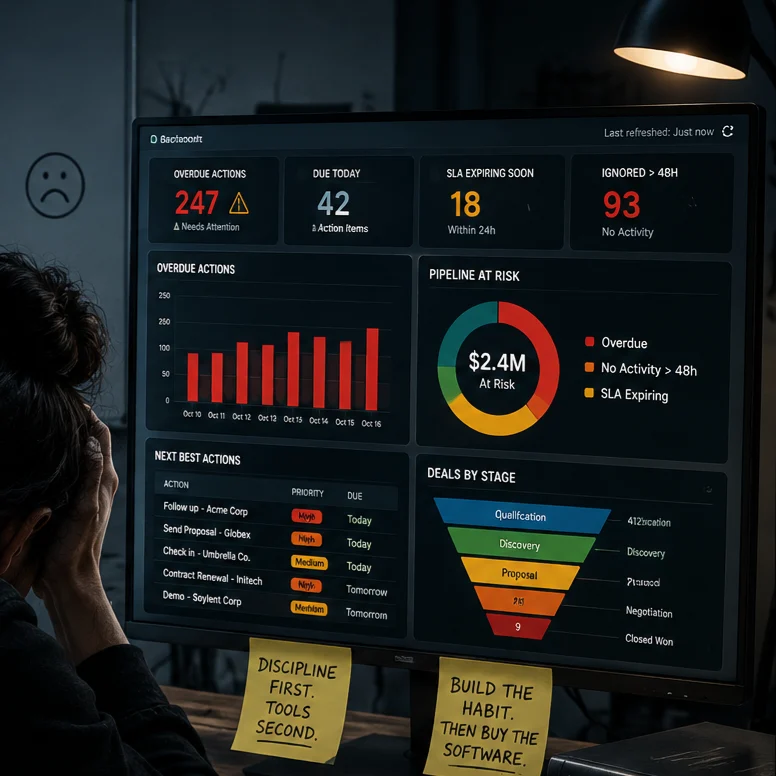
In October 2025, I joined a sales operations project at Stripe and discovered something terrifying.
There were 2,500 open leads PER PERSON in Salesforce.
Nobody was properly tracking them. There were no future activity settings, no automated follow-ups, and zero pipeline discipline. Instead, reps were working out of static, mistake-ridden Google Sheets or—worse—literally “raw-dawgging” their pipeline from pure memory.
Unsurprisingly, leads dropped into the void constantly. Every other week, an angry prospective client would resurface, demanding to know why our sales team had completely ghosted them.
Coming in with years of operational experience, I had an immediate tech-savior complex. I looked at this chaos and thought, “I’m going to build a system to save these poor bastards from themselves.”
So, I got to work.
Engineering the Flawless Dashboard
I interviewed the reps, mapped out their exact sales cycles, and locked myself away to build what I considered the absolute perfect dashboard.
In my book, a perfect dashboard satisfies one rule: It eliminates the need to look anywhere else for action items. It shouldn’t just display passive numbers; it needs to actively scream at you when something is broken.
The dashboard contained everything a rep needed to operate their day. It tracked new leads with explicit SLA expiration warnings, highlighted active deals that had been ignored for more than 48 hours, flagged approaching due dates for committed contracts, and isolated exactly what actions were due today or overdue.
When it was finished, I stared at it in awe. It was pristine. It was foolproof. I genuinely believed it was physically impossible for anyone to miss a deadline ever again.
The Polite Corporate Lie
Post-launch, I ran the training sessions, handed over the keys, and waited for the conversion rates to skyrocket.
Instead, I watched the dashboard die a slow, quiet death.
Within a few weeks, the backend data revealed a frustrating reality: only 2 out of the 6 reps were actually utilizing the dashboard. When I called a team meeting to address pipeline health, everyone nodded enthusiastically. They unanimously agreed that the dashboard was “incredible” and “helped a lot.”
This is the classic corporate polite lie. People love to praise a tool right before they minimize the tab and never open it again.
Month after month, the same pattern repeated. Except for those same two reps, everyone else continuously missed their deadlines. I would step in, clear the blockages, manually force everyone back to a clean slate of “zero overdues,” and within days, the chaos crew would slide right back into delinquency the moment the operational pressure was off.
The Moment It Clicked
The breakthrough didn’t happen while staring at the dashboard. It happened while staring at activity logs.
The two best-performing reps weren’t using the dashboard because it was good. They were using it because they already had a routine.
The dashboard wasn’t creating discipline. It was amplifying discipline that already existed.
When I looked closely at the activity logs of those two superstar reps, their actions formed a highly consistent, rhythmic pattern. Even during the chaotic, pre-dashboard era, they maintained a strict, predictable daily routine. They had planned days. They logged into their tools at the exact same time every morning. They had an internal clock and a habitual way of moving through tasks.
The other four reps? Their activity logs looked like a random number generator. Massive spikes of erratic cold-calling followed by days of absolute radio silence. They didn’t miss deadlines because the dashboard failed to alert them; they missed deadlines because they had no mental infrastructure to anchor the tool to their daily lives.
Tools Don’t Build Systems
The truth is that most people don’t suffer from a technology problem—they suffer from a utilization problem. Technology can only take people as far as they are willing to take themselves.
Good technology amplifies good systems. Bad systems just get amplified faster.
If you feed a broken, chaotic personal workflow into a world-class Salesforce dashboard, you don’t fix the chaos. You just get highly visible, beautifully formatted, color-coded chaos.
This isn’t a lesson for managers on how to badger their teams into clicking a button. This is a lesson for you—the individual professional, freelancer, or builder—staring at your own beautifully customized, yet entirely ignored, Notion pages, Trello boards, or CRM software.
If you jump straight into complex software without an underlying manual system, you are setting money and time on fire.
Before you adopt a new piece of technology, you need to pass what I call the Pen-and-Ink Baseline
The rule is simple: If you cannot manage a process manually for 7 days, software will not save you.
How to audit yourself before buying software:
- Strip Away the Automation: If you want to use a complex CRM or task manager, force yourself to track your daily top 5 action items in a completely raw, un-automated environment first. A physical notebook, a completely unformatted Google Sheet, or a basic text file.
- Prove the Habit: Execute that exact routine at the same time every day for one working week. Prove that you possess the behavioral discipline to manually input, track, and close out those items without a computer screaming at you to do it.
- Earn the Upgrade: If you fail the manual week, stop looking for better software. You have a process flaw or a habit flaw, not a technology flaw. Fix the human routine first. Only when the manual habit becomes muscle memory should you introduce the software to scale and amplify your capabilities.
Final Thoughts
Software is an amplifier, not a magic wand. It is a leverage multiplier for an existing behavioral baseline.
The best software in the world cannot compensate for a process you refuse to follow. Build the habit. Then buy the software.
Then Lilith.
Speaking of whom, I need to close out my operational logs for the day. My black cat has taken up residence directly across my left wrist, effectively locking down my operational capabilities until she decides otherwise.
What about you? Have you ever engineered a “perfect” digital system for yourself only to completely ignore it a week later? Let’s talk about it in the comments below.
Berminat dengan perkhidmatan kami?
Kongsi emel atau nombor WhatsApp anda untuk konsultasi percuma tentang projek anda!

Tech Briefing
Penyumbang yang memberi tumpuan kepada analisis teknologi praktikal, strategi perisian dan pandangan transformasi digital.